



Do you recall that memory? The one where Holi explodes across a dusty neighborhood street. The smell of gulal hangs in the air. Your grandmother is laughing from the doorway. Colour everywhere—on every face, every wall, all over that white kurta somebody definitely regretted wearing.
For those of us scattered across Fremont, Sunnyvale, Naperville, and Sugar Land, that memory hits differently. We try to celebrate Holi here in America with all the love we've got. But honestly, you haven't truly experienced Holi celebration unless you've actually stood in the narrow lanes of Barsana on the day of Lathmar Holi.
The word "Lathmar" comes from the Hindi word "lathi". As an Indian, you know its meaning. It is a stick. The interesting thing is that it does not mean an aggressive or conflict-filled celebration. What actually happens is that playful love and joy unfold. People from across the world go to the Braj region to participate in the centuries-old tradition.
The underlying story goes like this.
Lord Krishna constantly visits Barsana just to tease Radha and her friends, the gopis. The Lord played all sorts of pranks and threw colors on them. These were divine pastimes of the Lord. He stayed in Nandgaon. It was a small village near the village of Radha.
Krishna and his companions threw color-filled water on them playfully, drenching their clothes. Eventually, the gopi leader and her friends took lathis in their hands and drove Krishna and his friends away. However, there were some unlucky men, too. Such ones had to dress up as women and dance in the streets. That made people passing by laugh, creating moments of fun and joy.
More than 5,000 years have passed by. And the symbolic riot of colors is celebrated every year. During the event, men from Nandgaon show up like Krishna's representatives. Women of the sacred town greet them. It's a color-soaked and drum-thumping celebration of a legend that makes people laugh.
Celebrations happen in the Radha Rani Temple. It is on Bhanugarh Hill. For those who do not know, the temple is the only one dedicated to the divine consort in India. The air carries the faint sweetness of gulal. The sound of dhols begins as a murmur and then becomes a thunder as devotional singing fills the atmosphere. From there, you can overlook the entire town of the gopi leader.
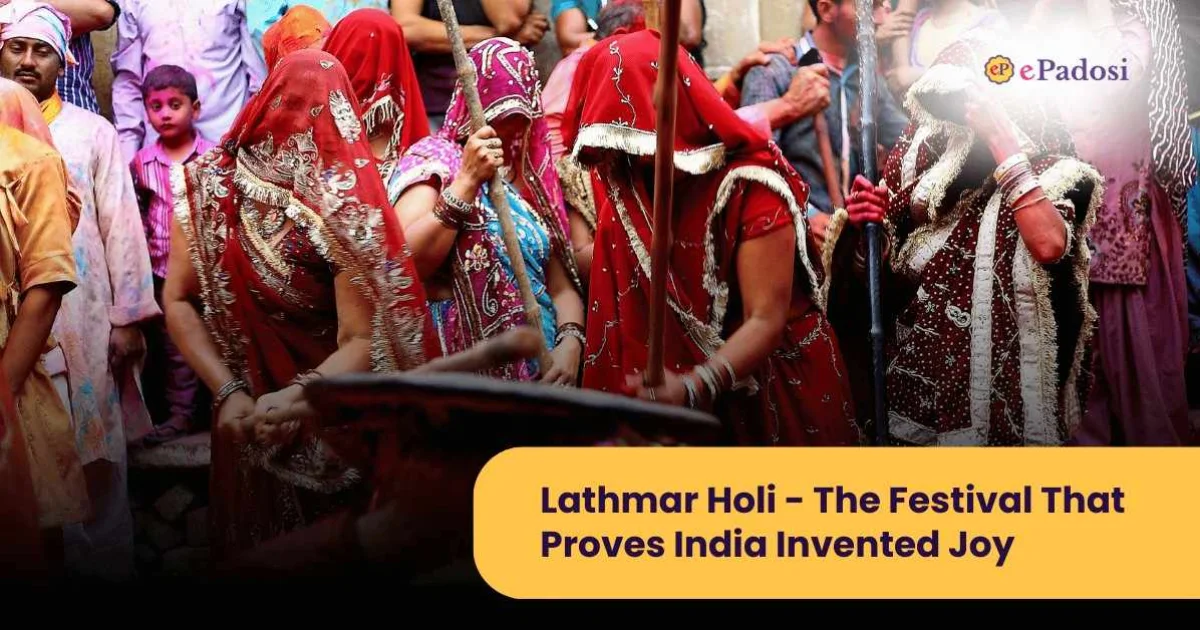
The men from Nandgaon arrive in a procession. They dress in traditional attire and sing Holi songs. They carry shields to protect themselves from the women who are waiting for them with lathis in hand. Women also dress in traditional clothings, such as lehenga-cholis of deep pink, gold, and green.
When men enter the town and reach the temple, the women descend on them in waves of laughter and colour. If a man is caught without his guard up, he is pulled aside and made to wear a sari. And, a dupatta is draped over his head. He is forced to dance in the street while the crowd roars. Everyone laughs and dances with joy.
The streets are filled with natural colours from Kesudo and Palash flowers. These brilliant orange and red blooms come from Gujarat and Jharkhand. They're gentle on skin and absolutely stunning to see. Then the next day? The script flips. Barsana's men travel to Nandgaon. The women from Barsana playfully wait there with their own lathis. Same playful strikes.
There's something deeper here than street spectacle. It's more than laughing at men with shields. Lathmar Holi is one of the oldest recorded festivals. Women hold the center of power here. Their agency isn't just permitted—it's celebrated loudly.
The women of the pilgrimage town are not playing victims. They are the inheritors of Radha's legacy. In the Braj tradition, Radha is not a supporting character. She's the one Krishna could never outsmart. To witness Lathmar Holi is to watch community affirmation. This happens every year for generations without stopping. The tradition is ancient and unbroken.
A grandmother raises her lathi. The crowd cheers. She connects with every woman before her. They all stood in that same lane. They all did the same thing. That continuity? It's not just beautiful. It is rare and extraordinary.
For Indians in America, our festivals lose their edges. Lathmar Holi is different. It's fully alive. The heritage lives inside the community that created it. The energy is not performed for tourists. Tourists are simply fortunate to stand inside it.
Expect to be completely unprepared for how much you will feel. That is an honest warning. First-time visitors describe arriving with cameras, leaving with homecoming feelings. This complete guide prepares you for the festivity.
The streets of the heavenly consort's village are narrow and completely occupied. The air turns pink, orange, and red quickly. The dhols do not stop. The singing does not stop. Someone will cover your face with Holi color. You will be glad they did.
Wear clothes you love but are prepared to retire. Apply oil to your skin and hair the night before. Locals do this because it makes the color wash off easier. Arrive a day early if you can. The Radha Rani Temple at pre-dawn is different. It's completely different from what comes after.
The temple's architecture against the Braj sky is stunning. Morning light makes it unforgettable. You'll remember it for decades. The celebrations run across multiple days. Day one is Laddu Holi in Barsana. Sweets are showered on the crowd from the temple. Day two is the main Holi — Lathmar Holi in Barsana. Day three carries the tradition to Nandgaon.
By day four, you reach Vrindavan. Phoolwalon Ki Holi floods the streets with flower petals. You'll stop photographing everything. You'll just stand still inside the beauty.
No honest account of Lathmar festival skips the food. Barsana's streets during March hit all your senses. Your nose, tongue, and eyes experience the festival.
Begin with gujiya. These deep-fried crescents are Holi's undisputed mascot. Every local family makes hundreds before the festival. Strangers will offer them. Accept every time. There's also malpua—soft, syrupy pancakes fried in ghee. They collapse gently on your tongue. Then there's kachori with spiced lentils. Tamarind chutney comes on the side—hot enough to clear sinuses.
But the drink defining Holi in Braj is Thandai. It's a chilled milk drink with almonds and rose petals. Add cardamom, saffron, fennel, and black pepper. It's everything the ingredients promise and then some more. Some versions include bhang, a cannabis preparation. It has deep roots in Hindu tradition. The locals offer it with calm, centuries-old confidence. If curious and comfortable, a glass is genuine culture. Not interested? No problem. The non-bhang version is incredible. It's the finest cold drink you'll have all March.
Bring cash in small denominations. The best food is not at restaurants. It's at small stalls where women fry gujiyas. Thirty at once, handed out in newspaper cones. Faster than people can eat them. This is how you enjoy the festival.
Mathura Vrindavan Holi 2026 falls on March 4th. Iconic Lathmar Holi celebrations extend from late February through early March. The schedule holi follows is predictable.
Getting to Barsana is manageable from anywhere. Even if it's your first time traveling this way. Here is your complete guide to reaching Barsana.
By Train
The closest major railway station is Mathura Junction. It's roughly 50 kilometers from Barsana. Mathura connects Delhi, Jaipur, Agra, and Varanasi. The train journey from Delhi takes approximately two hours. From Mathura, hire a taxi or take a bus. Barsana is about one hour away. Book trains well in advance. The entire region fills up during Holi week. The Rajdhani and Shatabdi trains are comfortable and reliable.
By Air
Fly into Indira Gandhi International Airport in Delhi. It's approximately 142 kilometers from Barsana. This is the most practical option from the USA. Agra is closer at 100 kilometers. But connections are very limited. Delhi remains your best option. From Delhi airport, a cab to Mathura takes three hours. Traffic can add to this. Mathura to Barsana is another hour. Book your airport transfer in advance. This is especially important during the Holi season.
By Road
The Yamuna Expressway from Delhi to Mathura is smooth. It rarely takes more than two and a half hours. From Mathura, state highway roads take you directly to Barsana. Or hire a taxi from Delhi for the full trip. It covers Barsana for the Lathmar festival. Then, Nandgaon the next day. Then Mathura and Vrindavan, after that. One trip covers the entire Holi arc. The priests and devotees at the Radha Rani Temple will already be there.
Lathmar Holi isn't just a festival to visit. It was a Lord's leela. It is a conversation with everything you came from. The sticks, shields, holi color, and dhols aren't souvenirs. Neither is that Thandai taste on a warm March afternoon. They're proof that your cultural heritage didn't need simplifying. It never needed explaining or being made palatable. It was always this magnificent. And it is waiting for you exactly where you left it.
Plan your visit for March 2026. Travel to Barsana in Mathura for this ancient, vibrant Hindu spring festival. Come as a devotee seeking spiritual fulfillment if you want. Or as a tourist witnessing one of the world's unique celebrations. Barsana welcomes you either way. Tease out the deeper meaning of the playful strikes. Listen to the temple rituals. That's the traditional Holi day.